






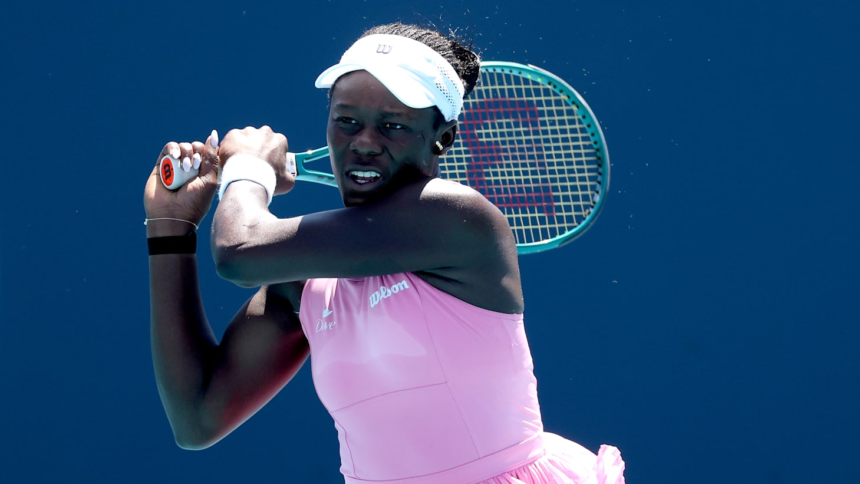
Victoria Mboko’s Breakthrough Moment: A Rising Force Reshaping Women’s Tennis
A Quarterfinal That Signals More Than Progress
The 2026 Miami Open has become a defining stage for one of tennis’s fastest-rising talents—Victoria Mboko. At just 18, the Canadian has moved beyond being labeled a “prospect” and is now firmly positioned as a contender after powering into the quarterfinals with a statement victory over Mirra Andreeva.
- A Quarterfinal That Signals More Than Progress
- The Match That Defined the Moment
- A Season Built on Consistency and Growth
- Tactical Identity: Power, Precision, and Endurance
- The Muchova Test: Next Step in Miami
- A Symbol of a Generational Shift
- Beyond Results: What Mboko Represents
- Conclusion: From Prospect to Contender
Her 7-6(4), 4-6, 6-0 win was not merely about progression in a tournament bracket. It was a demonstration of composure, tactical awareness, and physical resilience—qualities typically associated with seasoned professionals rather than emerging teenagers.
The Match That Defined the Moment
Facing Andreeva—her doubles partner and a rising star in her own right—Mboko entered a contest shaped as much by familiarity as by rivalry. Both players knew each other’s patterns, tendencies, and weaknesses, turning the match into a tactical duel rather than a straightforward power exchange.
The opening set was tightly contested, with both players trading momentum. Mboko’s ability to reset under pressure proved decisive, edging the tiebreak 7-4. The second set saw Andreeva respond, capitalizing on a brief lapse to level the match.



But the third set was where Mboko’s trajectory became unmistakable. She dismantled her opponent 6-0, breaking serve three times and finishing with authority—an inside-out forehand that encapsulated her aggressive style.
“It’s always tough to play against someone you have trained with,” Mboko said afterward. “But I had to focus on my game and stick to my strategy.”



Andreeva, equally composed in defeat, acknowledged the challenge: “Victoria played a great match today… I am confident we will continue to push each other to be better.”
A Season Built on Consistency and Growth
Mboko’s Miami run is not an isolated surge. It is the continuation of a broader pattern that has defined her 2026 season.
- Fourth-round appearance at the Australian Open
- Quarterfinal run at Indian Wells
- Multiple deep tournament finishes across the calendar
- Five top-10 wins already this season
Her only significant setbacks have come against the world number one, Aryna Sabalenka—losses that, rather than diminishing her profile, have reinforced the level she is competing at.
Former U.S. Open champion Andy Roddick has been particularly emphatic in his assessment:



“Mboko is going to win a slam in the next two years… She’s making the quarters or better in every single event.”
This level of consistency, especially at her age, is rare. It reflects not just talent but a rapidly maturing competitive framework.
Tactical Identity: Power, Precision, and Endurance
Mboko’s rise is anchored in a clearly defined playing identity.
Aggressive Baseline Control
She dictates rallies with heavy groundstrokes, often pushing opponents deep behind the baseline.
Strategic Shot Placement
Rather than relying purely on power, she uses angles and placement to open the court—an approach that was particularly effective against Andreeva.
Physical Resilience
Her ability to sustain intensity across long three-set matches has become a hallmark. The 6-0 final set in Miami is a case study in endurance-driven dominance.
Roddick highlighted this aspect directly, noting her capacity to “withstand the stress test of big tennis.”
The Muchova Test: Next Step in Miami
Mboko’s reward for her quarterfinal breakthrough is a high-stakes encounter with Karolina Muchova, one of the most technically versatile players on the tour.
Muchova arrives in strong form after dismantling Alexandra Eala 6-0, 6-2, setting up a stylistic clash:
- Mboko’s power and tempo
- Muchova’s variation and tactical fluidity
Prediction markets reflect how evenly balanced the matchup is, with Mboko holding a slight edge at 51% to Muchova’s 49%. This narrow margin underscores both Mboko’s rapid rise and the uncertainty surrounding her ceiling.
A Symbol of a Generational Shift
Mboko’s ascent is not occurring in isolation. It is part of a broader transformation within women’s tennis, where a new generation is challenging established hierarchies.
Players like Mboko and Andreeva are redefining expectations:
- Younger entrants reaching advanced stages of major tournaments
- Increased physicality and athleticism at earlier career stages
- Greater tactical sophistication among teenage players
This shift is reshaping the competitive landscape, making tournaments less predictable and more dynamic.
Beyond Results: What Mboko Represents
Mboko’s journey carries implications beyond rankings and titles.
For Canadian Tennis
She reinforces Canada’s growing influence in the sport, following recent successes from players across both tours.
For the WTA Tour
Her emergence adds depth and narrative intrigue, essential for sustaining global engagement.
For Fans
She represents a player who blends raw talent with visible development—a trajectory that audiences can follow in real time.
Conclusion: From Prospect to Contender
Victoria Mboko’s quarterfinal run at the Miami Open is not simply a milestone—it is a signal. A signal that her transition from rising talent to genuine contender is already underway.
Her ability to combine consistency, resilience, and tactical clarity at such an early stage suggests that the predictions surrounding her future may not be premature. If anything, they may be conservative.
With a quarterfinal clash against Karolina Muchova looming, the immediate question is how far she can go in Miami. The broader question—how quickly she can reach the top of the sport—no longer feels hypothetical.