






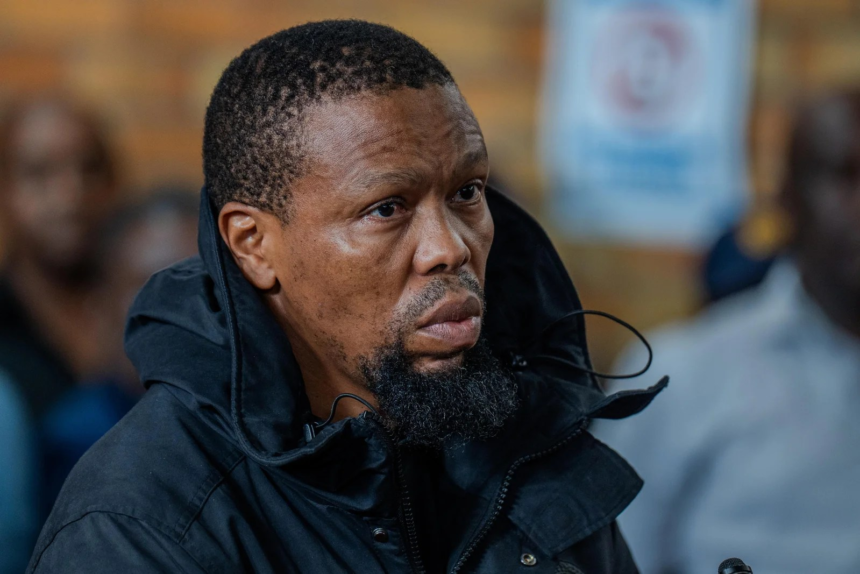
Inside the Matipandile Sotheni Case: What It Reveals About South Africa’s Security Crisis
A Case That Has Shaken Public Confidence
The arrest and court appearance of Matipandile Sotheni, a former member of South Africa’s elite police unit, has triggered a wave of concern across law enforcement and the broader public. At the centre of the case is the killing of Marius van der Merwe, also known as “Witness D,” a key figure in the Madlanga Commission of Inquiry.
- A Case That Has Shaken Public Confidence
- Who Is Matipandile Sotheni?
- The Charges: A High-Stakes Legal Battle
- The Killing of “Witness D”
- The Missing Mastermind
- Weapons and Evidence
- A System Under Pressure: The Private Sector Factor
- Impact on the Victim’s Family
- What Happens Next?
- A Case With National Implications
Sotheni’s alleged involvement is not just another criminal case. It raises deeper structural questions about policing, accountability, and the migration of highly trained officers into private and potentially illicit networks.
Who Is Matipandile Sotheni?
Matipandile Sotheni, 41, is not an ordinary suspect. His background places him among the most highly trained operatives within South Africa’s policing system.
-
Joined the police in 2005
-
Became part of the Special Task Force (STF) in 2010
-
Received training costing the state at least R1-million
-
Resigned from SAPS in 2019
-
Transitioned into the private security sector
According to national police spokesperson Athlenda Mathe, Sotheni possessed specialised tactical skills “close to those of a sniper.”



This level of expertise is central to the allegations. Investigators believe he was specifically recruited because of his precision and operational capability.
The Charges: A High-Stakes Legal Battle
Sotheni faces a series of serious charges, reflecting the gravity of the case:



-
Premeditated murder
-
Conspiracy to commit murder
-
Three counts of attempted murder
-
Possession of unlicensed firearm and ammunition
The attempted murder charges relate to members of Van der Merwe’s family, who were present during the attack.
The case has been classified under Schedule 6 offences, indicating the highest level of seriousness under South African law. As a result, the state has signaled its intention to oppose bail.
The matter has been postponed to 25 March 2026 for a formal bail application.
The Killing of “Witness D”
The murder of Marius van der Merwe is central to the case and carries broader political and institutional implications.



Van der Merwe had testified before the Madlanga Commission about:
-
Alleged torture methods used by law enforcement
-
The involvement of Ekurhuleni Metro Police Department (EMPD) officers
-
Links between private security actors and state policing structures
Despite testifying off-site and off-camera, he was tracked and killed on 5 December 2025 outside his home in Brakpan.
The attack was executed with precision. As Mathe stated:
“They knew he would do a clean job – only one shot killed Witness D.”
The killing occurred in full view of his wife and two minor children, intensifying the emotional and societal impact of the crime.
The Missing Mastermind
While Sotheni has been arrested, investigators believe he did not act alone.
Key points from the investigation:
-
The alleged mastermind remains at large
-
Surveillance on Van der Merwe began around late November 2025
-
Sotheni allegedly carried out the hit as a “side hustle”
-
He is believed to have acted under instructions from another party
Police are actively pursuing additional suspects, and more arrests are expected.
Weapons and Evidence
The investigation has uncovered significant material evidence:
-
125 rounds of R5 rifle ammunition
-
31 rounds of R1 rifle ammunition
-
19 rounds of 9mm pistol ammunition
All were found in Sotheni’s possession without a valid licence.
Additionally, authorities are searching for the AK-47 believed to have been used in the murder. Several properties are currently under investigation as potential hiding locations for the weapon.
A System Under Pressure: The Private Sector Factor
Beyond the immediate criminal case, the Sotheni matter highlights a systemic issue within South African policing.
According to Athlenda Mathe:
“Its quite disturbing that our tactical operators are being scouted by these wealthy individuals and private companies… the government cannot match their salaries.”
This trend has created a pipeline where:
-
Highly trained officers leave public service
-
They enter private security roles
-
Some become vulnerable to illegal or unethical operations
Mathe further warned:
“If a person orders you to do something and they are paying you, I think it becomes quite difficult to say no because you’ve already resigned from the SAPS.”
This dynamic raises critical concerns about:
-
State investment leakage (training costs not retained in public service)
-
Accountability gaps
-
Potential criminal exploitation of elite skills
Impact on the Victim’s Family
The human cost of the case remains severe.
Van der Merwe’s sister, Natasha, described the emotional toll:
“It has been a roller-coaster ride for us as a family… we have been waiting for three months as we have so many questions.”
The family has also reported receiving death threats, further compounding the trauma.
Authorities have confirmed that these threats are under investigation.
What Happens Next?
The upcoming bail hearing on 25 March 2026 will be a critical milestone. However, the broader trajectory of the case depends on several unresolved elements:
-
Identification and arrest of the alleged mastermind
-
Recovery of the murder weapon
-
Establishing the full network behind the killing
-
Determining whether institutional corruption played a role
Police have indicated that the investigation remains active and expanding.
A Case With National Implications
The Matipandile Sotheni case is not isolated. It sits at the intersection of multiple systemic challenges:
-
The integrity of law enforcement institutions
-
The influence of private security networks
-
The safety of whistleblowers and witnesses
-
The long-term consequences of losing elite officers to private interests
It also raises a fundamental question: What happens when the state’s most highly trained protectors become part of the threat landscape?
As the investigation unfolds, the answers may reshape public trust in South Africa’s security framework.