






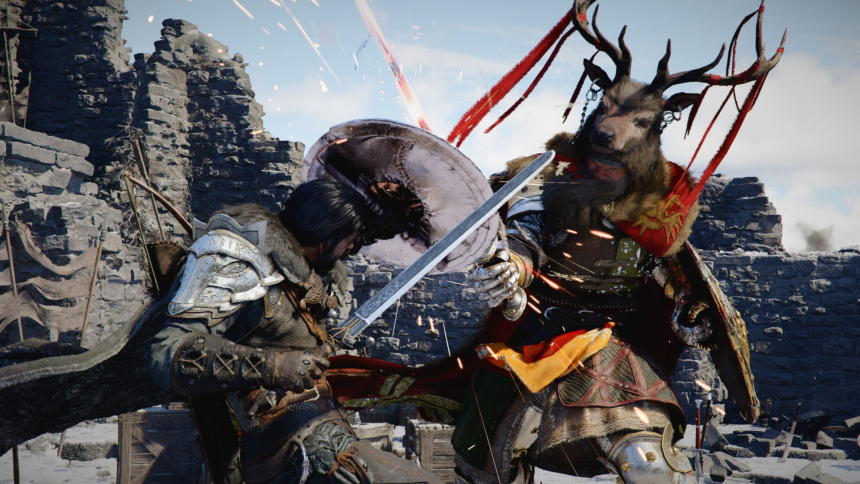
Crimson Desert Gameplay: Ambition, Scale, and the Cost of Doing Everything
A High-Risk Vision Meets Reality
After nearly seven years of development and an estimated 200 billion won investment, Pearl Abyss positioned Crimson Desert as a flagship release—an expansive open-world RPG intended to rival the genre’s most influential titles.
- A High-Risk Vision Meets Reality
- The Core Gameplay Philosophy: Everything, Everywhere, All at Once
- Open-World Gameplay: Scale That Impresses
- Combat Systems: Spectacle Versus Sustainability
- Systems Overload: When Complexity Becomes Friction
- Puzzles, Stealth, and Experimental Mechanics
- Skill Trees and Progression: Innovation With Redundancy
- Technical Performance: A Clear Strength
- Narrative Gameplay: The Weakest Link
- Market Impact: Gameplay Reception Drives Financial Fallout
- What This Means for the Future of Large-Scale RPGs
- Conclusion: A Game Defined by Extremes
The gameplay ambition is immediately clear: Crimson Desert attempts to merge the systemic freedom of sandbox worlds with cinematic storytelling and dense RPG mechanics. However, early reviews and player impressions suggest a more complicated outcome—one defined by extremes rather than consistency.
With a Metacritic score of 78 and several outlets citing uneven execution, the gameplay itself has become the central point of debate—and the primary driver behind the sharp 29% drop in Pearl Abyss shares.
This is not a conventional failure. It is a case study in scale versus cohesion.



The Core Gameplay Philosophy: Everything, Everywhere, All at Once
At its foundation, Crimson Desert is built around a hybrid gameplay loop combining:
-
Open-world exploration
-
Real-time combat systems
-
Dynamic NPC-driven environments
-
Puzzle-solving mechanics
-
Resource management and settlement systems
The design appears intentionally maximalist. The game draws clear inspiration from genre benchmarks such as The Witcher 3: Wild Hunt, Red Dead Redemption 2, and The Legend of Zelda: Tears of the Kingdom—but instead of refining a single identity, it attempts to synthesize all of them simultaneously.



The result is a gameplay experience that feels expansive, but often lacks specialization.
Open-World Gameplay: Scale That Impresses
A Living, Reactive Environment
The strongest aspect of Crimson Desert gameplay lies in its world design.
Players are placed in a massive, interconnected environment where NPCs follow routines, settlements evolve in real time, and player decisions can ripple across regions. For example:
-
Caravans and workers visibly construct structures during the day
-
NPCs engage in dynamic behaviors, such as theft or bounty evasion
-
Players can intervene in these systems—or ignore them entirely
This creates a sense of systemic immersion rarely seen at this scale.



Freedom of Playstyle
Gameplay is not linear. Players can:
-
Hunt wildlife and cook food for survival advantages
-
Engage in side activities like fishing, gambling, or arm wrestling
-
Build and manage small settlements
-
Explore off-path regions long before main story progression
This “do-anything” approach gives the game its most compelling moments—where experimentation leads to emergent gameplay rather than scripted outcomes.
Combat Systems: Spectacle Versus Sustainability
Large-Scale Encounters
Combat in Crimson Desert emphasizes scale. Encounters frequently involve:
-
Dozens of enemies simultaneously
-
Multi-wave battles extending over several minutes
-
War-like scenarios requiring objective-based actions under pressure
While visually impressive, this design introduces pacing issues. Many encounters feel prolonged rather than strategic, especially when repeated frequently.
Boss Fights: A Different Game Entirely
Boss battles shift dramatically into a more punishing, “soulslike” structure:
-
Multi-phase enemies
-
High damage output
-
Heavy reliance on healing resources
This creates a mechanical disconnect. The core combat system encourages broad, chaotic engagements, while boss fights demand precision and mastery—two philosophies that rarely align seamlessly.
Systems Overload: When Complexity Becomes Friction
Inventory and Resource Constraints
One of the most criticized gameplay mechanics is inventory management:
-
Limited space forces players to discard items frequently
-
No storage chest system exists
-
Loot collection—central to RPG satisfaction—becomes a liability
This undermines progression incentives, particularly in a game built around exploration and reward accumulation.
Control Mapping and Input Design
Control complexity further compounds the issue:
-
Multi-step button combinations are required for basic abilities
-
Key actions are mapped unintuitively (e.g., sprinting mechanics)
-
High cognitive load reduces accessibility
For a game with dozens of abilities and systems, the control scheme introduces unnecessary friction rather than enabling mastery.
Puzzles, Stealth, and Experimental Mechanics
Crimson Desert attempts to diversify gameplay through additional systems:
-
Puzzle-solving sequences
-
Stealth-based missions
-
Environmental traversal challenges
However, these elements often lack refinement. Puzzles can feel unintuitive, with solutions discovered through trial-and-error rather than logic. Stealth sections, meanwhile, are widely seen as underdeveloped and inconsistent with the core gameplay loop.
This reinforces a recurring theme: breadth without depth.
Skill Trees and Progression: Innovation With Redundancy
Character progression is built around branching skill trees offering:
-
Mobility upgrades (gliding, grappling, wall-scaling)
-
Combat abilities (shield bashes, aerial attacks)
-
Specialized skill paths
Some abilities significantly enhance gameplay fluidity—particularly movement mechanics that enable rapid traversal across large environments.
However, redundancy is a notable issue:
-
Many combat skills feel functionally similar
-
Certain paths (e.g., archery) lack responsiveness
-
Memorization of complex input sequences discourages experimentation
The progression system introduces variety, but not always meaningful differentiation.
Technical Performance: A Clear Strength
Visual Fidelity and Stability
On a technical level, Crimson Desert performs impressively:
-
Stable frame rates across multiple hardware configurations
-
Highly detailed environments and large-scale battle scenes
-
Strong optimization for a game of its size
The world is visually striking, particularly at a distance, where landscapes and environmental density are most effective.
Bugs and Stability Issues
Despite strong performance, technical issues persist:
-
Hard crashes during gameplay
-
NPC pathfinding failures
-
Quest progression bugs, including one requiring a reload from seven hours earlier
These issues are not uncommon in large-scale RPGs, but their impact—particularly on progression—remains significant.
Narrative Gameplay: The Weakest Link
While gameplay systems aim high, the narrative integration struggles:
-
Story arcs lack cohesion and emotional investment
-
Characters are described as forgettable
-
Dialogue often undermines immersion
This is particularly problematic given the game’s reliance on cutscenes and companion interactions, which assume a level of player engagement that the writing does not consistently support.
Market Impact: Gameplay Reception Drives Financial Fallout
The reception of Crimson Desert gameplay has had immediate financial consequences.
-
Metacritic score: 78
-
Market expectation: mid-to-high 80s
-
Share price drop: 28.96% (to 46,600 won as of 11:27 a.m.)
While technically a positive score, the gap between expectation and reality has significantly affected investor sentiment.
The gameplay—rather than marketing or release timing—has become the central factor shaping both critical and financial outcomes.
What This Means for the Future of Large-Scale RPGs
Crimson Desert highlights a broader industry tension:
-
Expanding feature sets versus maintaining design coherence
-
Player freedom versus mechanical clarity
-
Scale versus polish
The game demonstrates that ambition alone is insufficient. Without consistent execution, even the most technically impressive systems can feel fragmented.
Conclusion: A Game Defined by Extremes
Crimson Desert gameplay is neither a clear success nor a failure. It is a high-variance experience—marked by moments of genuine brilliance and equally notable frustration.
At its best, it delivers:
-
A living, reactive world
-
Unprecedented gameplay freedom
-
Technical excellence
At its worst, it struggles with:
-
Overextended systems
-
Inconsistent combat design
-
Weak narrative integration
The result is a game that is difficult to categorize—and even harder to recommend unequivocally.
For players, it represents a bold experiment. For the industry, it serves as a reminder that scale must be matched by discipline.