






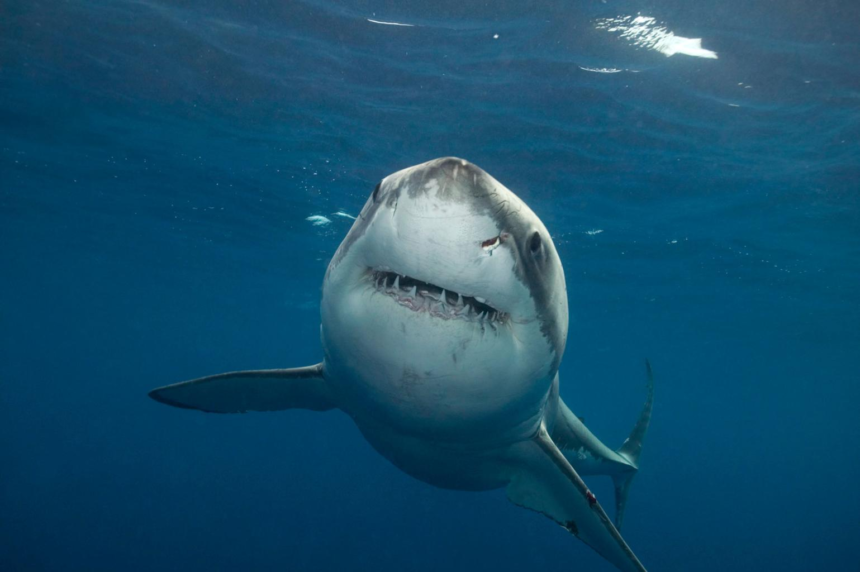
Great White Shark: Inside the Movements, Myths, and Science of the Ocean’s Apex Predator
A Predator That Commands Both Fear and Fascination
Few creatures in the natural world inspire as much intrigue as the great white shark. Powerful, elusive, and often misunderstood, this apex predator has long occupied a unique space between scientific curiosity and public anxiety.
- A Predator That Commands Both Fear and Fascination
- The “Contender” Case: A Rare Glimpse Into Shark Behavior
- Migration Patterns: Why Great Whites Appear in Warmer Waters
- Breeding Mysteries: What Scientists Still Don’t Know
- Public Concern vs. Scientific Reality
- A Surge in Sightings: A Broader Pattern
- Cultural Impact: Fear, Media, and the Reality Gap
- The Future of Shark Research and Conservation
- Conclusion: Beneath the Surface, a Different Story
That tension resurfaced recently with the tracking of a massive great white named “Contender,” a nearly 14-foot, 1,653-pound specimen moving along the northeastern coastline of Florida. His presence near a popular spring break destination reignited familiar questions: How dangerous are great white sharks? Why are they here? And what are scientists learning from tracking them?
The answers, as it turns out, are more nuanced—and more revealing—than the headlines suggest.
The “Contender” Case: A Rare Glimpse Into Shark Behavior
The tracking of Contender represents more than a single sighting. It is part of a broader scientific effort led by OCEARCH, a marine research organization specializing in tagging and monitoring large ocean predators.



Contender is not just notable for his size—he is considered one of the most significant great white sharks ever recorded in the Atlantic. His movements are monitored through a system that generates a “ping” whenever his dorsal fin breaks the surface, allowing researchers to map his location in near real time.
His latest recorded position placed him off the coast near St. Augustine, Florida—coinciding with one of the busiest tourist periods of the year.



For scientists, however, the timing is less coincidence and more confirmation of known patterns.
Migration Patterns: Why Great Whites Appear in Warmer Waters
Seasonal Movement Along the Atlantic
Great white sharks follow highly predictable migratory routes. During colder months, they move south toward warmer waters, tracking the southeastern United States coastline in late winter and early spring.
Florida becomes a critical waypoint in this journey for two primary reasons:
- Temperature: Warmer waters provide a stable environment during seasonal transitions
- Food Supply: The region offers abundant prey, making it an ideal feeding ground
Contender’s presence off Florida aligns precisely with this seasonal migration pattern. It is not unusual—it is expected.



The Gulf Stream Corridor
Great whites often travel along the Gulf Stream, a powerful ocean current that acts as a migratory highway. This allows them to cover vast distances efficiently, sometimes spanning thousands of miles within a single year.
From Florida, sharks like Contender may:
- Continue south toward South Florida
- Move east into deeper offshore waters along the Gulf Stream
- Reverse direction and migrate north toward the Carolinas and New England as temperatures rise
This cyclical movement defines much of great white behavior in the Atlantic.
Breeding Mysteries: What Scientists Still Don’t Know
While feeding patterns and migration routes are relatively well understood, breeding behavior remains one of the biggest unanswered questions in marine biology.
Spring appears to overlap with reproductive activity in great white sharks, but researchers have yet to definitively identify:
- Exact mating locations
- Timing of breeding cycles
- Nursery habitats for young sharks
Tracking large, mature specimens like Contender provides rare data that may help close these gaps. His movements could be linked not only to feeding but also to reproductive patterns—making him scientifically valuable beyond his size.
Public Concern vs. Scientific Reality
How Close Are Sharks to Swimmers?
Despite the proximity suggested by tracking data, context is critical. OCEARCH researchers emphasize that sharks like Contender typically remain miles offshore, far from the shallow waters where most people swim.
Great white sharks:
- Prefer deeper, cooler waters
- Follow prey species that are rarely found near crowded beaches
- Do not actively seek out humans as prey
The “ping” system only indicates when the shark surfaces—not that it is near swimmers.
The Statistics Behind Shark Encounters
Florida consistently records a high number of shark encounters globally, accounting for approximately 38% of incidents worldwide. However, this statistic requires interpretation.
The high percentage is largely due to:
- The volume of people entering the water
- Extensive coastline and recreational activity
Most incidents are:
- Non-fatal
- Extremely rare relative to the number of ocean users
Great white sharks, in particular, are less commonly involved in nearshore interactions compared to other species.
A Surge in Sightings: A Broader Pattern
Contender is not an isolated case. Recent tracking data shows increased activity of large sharks along U.S. coastlines.
Other notable observations include:
- A shark named Bella detected off Florida’s Gulf Coast near Sarasota
- A large specimen described as “a monster” spotted off Florida’s Space Coast
- Historical tracking of sharks like Breton and Mahone moving through similar routes
This clustering is not a sign of rising danger—it is evidence of an active migration season.
Cultural Impact: Fear, Media, and the Reality Gap
The great white shark occupies a unique position in public imagination. Popular media has often portrayed it as a relentless threat, reinforcing fear-driven narratives.
However, scientific data consistently tells a different story:
- Great whites are highly selective predators
- Human encounters are incidental, not intentional
- Their ecological role is essential for maintaining marine balance
The renewed attention around Contender highlights this gap between perception and reality. For beachgoers, the presence of a 1,600-pound predator nearby may feel alarming. For researchers, it is a rare opportunity to gather critical data.
The Future of Shark Research and Conservation
Technology-Driven Insights
Advancements in tracking technology—such as satellite tagging and real-time ping systems—are transforming how scientists study marine life.
These tools allow researchers to:
- Map migration routes with precision
- Understand behavioral patterns across seasons
- Identify potential breeding and feeding zones
Contender’s tracking is part of a broader shift toward data-driven marine science.
Conservation Implications
Great white sharks are vital to ocean ecosystems. As apex predators, they regulate prey populations and maintain ecological balance.
Understanding their movements is essential for:
- Protecting critical habitats
- Reducing human-wildlife conflict
- Informing sustainable marine policies
The more data researchers collect, the more effective conservation strategies become.
Conclusion: Beneath the Surface, a Different Story
The appearance of a massive great white shark near a busy coastline may capture attention, but it does not signal immediate danger. Instead, it offers a window into the complex, largely hidden world of ocean migration and predator behavior.
Contender’s journey underscores a broader reality: the ocean is not empty—it is structured, seasonal, and governed by patterns that science is only beginning to fully understand.
For the public, the takeaway is measured reassurance. For researchers, it is an invaluable dataset. And for the great white shark itself, it is simply another leg of a long, instinct-driven migration through one of the most dynamic ecosystems on Earth.