






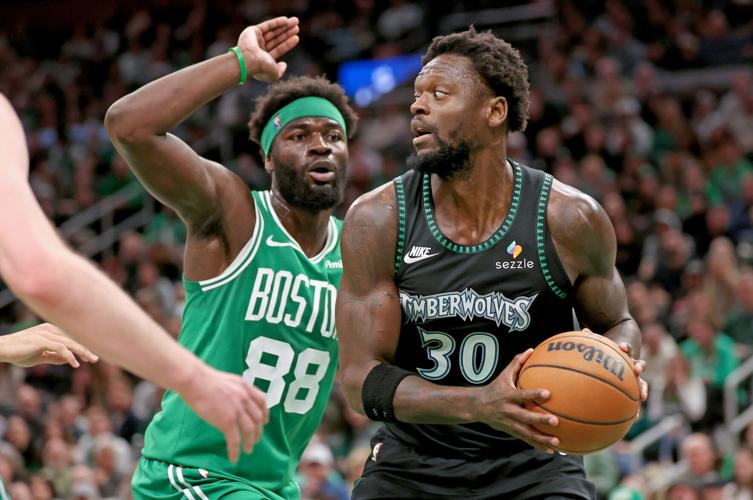
Celtics vs Timberwolves: How Minnesota Engineered a Statement Comeback in Boston
A Night That Flipped the Script
For much of the evening at TD Garden, the game followed a familiar pattern: the Boston Celtics controlling tempo, feeding off a packed home crowd, and building a comfortable early cushion.
- A Night That Flipped the Script
- Early Control: Celtics Dictate the First Half
- The Turning Point: A 16–0 Run That Changed Everything
- Bench Production: The Defining Factor
- Breaking a Long-Standing Barrier
- Tactical Insight: What Minnesota Did Differently
- Standings Context: Why This Result Matters
- Wider League Context: A Night of Contrasts
- What This Means Moving Forward
- Conclusion: More Than a Single Game
Then, without warning, the narrative shifted.
The Minnesota Timberwolves — missing their star guard Anthony Edwards due to right knee inflammation — delivered one of the most composed and decisive fourth-quarter turnarounds of the NBA season, securing a 102–92 victory on the road.
This was not just a win. It was a performance that revealed structural resilience, bench depth, and tactical discipline under pressure.



Early Control: Celtics Dictate the First Half
Boston began with authority, pushing the Timberwolves onto the back foot early. By the second quarter, the Celtics had stretched their lead to 15 points, capitalizing on defensive pressure and crowd momentum.
In most scenarios, that margin at home — particularly in front of 19,156 fans — signals control. The Celtics appeared on course to reinforce their position near the top of the Eastern Conference standings, where they sit at 47–24.


However, their early dominance masked a critical vulnerability: an inability to sustain scoring consistency when defensive intensity drops.
The Turning Point: A 16–0 Run That Changed Everything
The fourth quarter delivered the decisive sequence.
Minnesota launched a 16–0 run, flipping a deficit into control within minutes. Over the final period, the Timberwolves outscored Boston 26–15, effectively silencing the arena.
This stretch was not driven by a single superstar performance. Instead, it reflected coordinated execution:



- Defensive stops translating into transition opportunities
- Efficient perimeter shooting
- Controlled ball movement against a retreating Celtics defense
The shift exposed Boston’s inability to respond under sustained pressure — a concern that may carry implications heading into postseason play.
Bench Production: The Defining Factor
With Edwards sidelined, Minnesota’s supporting cast stepped into primary roles.
Key Contributors
- Bones Hyland — 23 points (off the bench)
Delivered scoring bursts at critical moments, particularly during the fourth-quarter surge. - Jaden McDaniels — 19 points
Balanced offensive contribution with defensive discipline. - Ayo Dosunmu — 17 points
Provided stability in ball handling and shot creation. - Rudy Gobert — 9 points, 14 rebounds, 4 blocks
Anchored the interior defense, limiting second-chance opportunities for Boston.
This distribution underscores a key structural advantage: Minnesota does not rely exclusively on its headline star to remain competitive.
Breaking a Long-Standing Barrier
The result carried historical significance beyond the standings.
Minnesota ended an 18-game losing streak at TD Garden, a venue that had long proved inhospitable. The last time the Timberwolves secured a win in Boston dates back nearly two decades.
Breaking that pattern signals a psychological shift as much as a competitive one. Teams often carry venue-specific narratives; dismantling them can have lasting effects on confidence and identity.
Tactical Insight: What Minnesota Did Differently
1. Defensive Discipline in the Final Quarter
The Timberwolves tightened rotations and forced Boston into low-efficiency shots. The Celtics’ offense stagnated as passing lanes closed and interior space disappeared.
2. Bench-Led Offensive Flexibility
Rather than forcing isolation plays, Minnesota relied on ball movement and spacing. This created open looks, particularly from beyond the arc.
3. Composure Without Edwards
The absence of Edwards could have disrupted offensive hierarchy. Instead, it redistributed responsibility, resulting in a more balanced attack.
Standings Context: Why This Result Matters
The victory lifts Minnesota to 44–28, keeping them firmly in sixth place in the Western Conference — a critical cutoff for direct playoff qualification.
In the Western standings:
- Top six teams advance directly to the playoffs
- Positions 7–10 enter the play-in tournament
Maintaining sixth place avoids the volatility of the play-in format, making wins like this strategically significant.
Meanwhile, Boston remains second in the East but faces increased pressure from the New York Knicks (47–25), who are closing the gap.
Wider League Context: A Night of Contrasts
While Minnesota executed a comeback in Boston, other results highlighted contrasting narratives across the league:
- The Knicks dominated the Washington Wizards 145–113 in a one-sided contest
- Nikola Jokic recorded his 35th triple-double of the season, leading the Denver Nuggets to victory over the Portland Trail Blazers
These outcomes reinforce the competitive density across both conferences, where margins between contenders continue to narrow.
What This Means Moving Forward
For the Timberwolves
- Demonstrated capacity to win without their primary scorer
- Reinforced depth as a competitive advantage
- Strengthened position in the playoff race
For the Celtics
- Highlighted vulnerability in closing games
- Raised questions about late-game execution
- Increased pressure amid tightening Eastern Conference standings
Conclusion: More Than a Single Game
The Timberwolves’ 102–92 win over the Celtics is best understood as a structural statement rather than an isolated result.
It showcased a team capable of adapting under adversity, executing collectively, and overturning unfavorable momentum in a hostile environment. For Boston, it served as a reminder that early dominance does not guarantee control — particularly against teams with depth and tactical discipline.
As the regular season moves toward its decisive phase, performances like this will shape not just standings, but expectations.