




Madrid Derby Rewritten: Tactical Risk, Star Redemption, and a Title Race Reignited
A Five-Goal Night That Shifted the Season’s Momentum
The latest chapter of the Madrid derby delivered exactly what its reputation demands—intensity, unpredictability, and decisive moments that ripple beyond ninety minutes. On March 22, 2026, Real Madrid edged Atlético Madrid 3–2 in a high-stakes La Liga encounter that may ultimately define the trajectory of the title race.
- A Five-Goal Night That Shifted the Season’s Momentum
- Arbeloa’s Gamble: Benching Mbappé in a Derby
- Atlético Strike First: Lookman Sets the Tone
- Vinícius Júnior’s Response: From Jeers to Applause
- Valverde’s Influence: The Midfield Engine
- Tactical Structure: Why the System Worked
- A Turning Point in the Title Race
- Atlético Madrid: Competitive but Marginally Short
- What This Match Signals About Modern Football
- What Comes Next: Reinforcements and Expectations
- Conclusion: A Derby That Redefined Belief
This was not simply another derby victory. It was a match shaped by calculated risk, individual resurgence, and a tactical blueprint that signals a broader evolution under Real Madrid’s new leadership.
Arbeloa’s Gamble: Benching Mbappé in a Derby
The most scrutinized decision came before kickoff. Manager Álvaro Arbeloa opted to leave Kylian Mbappé on the bench—despite the forward being fit and having participated fully in pre-match training.
Arbeloa had previously stated:



“Kylian Mbappé ‘will play for sure tomorrow,’ but I didn’t confirm a starting position.”
That nuance proved critical. Instead of building around a marquee name, Arbeloa prioritized structural balance and recent form, selecting Vinícius Júnior and Brahim Díaz to lead the attack.


The decision reflected a modern managerial approach: tactical coherence over star hierarchy.
Atlético Strike First: Lookman Sets the Tone
Atlético Madrid began with purpose and discipline. Ademola Lookman opened the scoring, capitalizing on early momentum and linking effectively with Antoine Griezmann and Koke.
The goal reinforced Atlético’s identity—compact, opportunistic, and ruthless in transition. For a brief period, the match tilted in their favor, with Real Madrid forced to recalibrate under pressure.
Vinícius Júnior’s Response: From Jeers to Applause
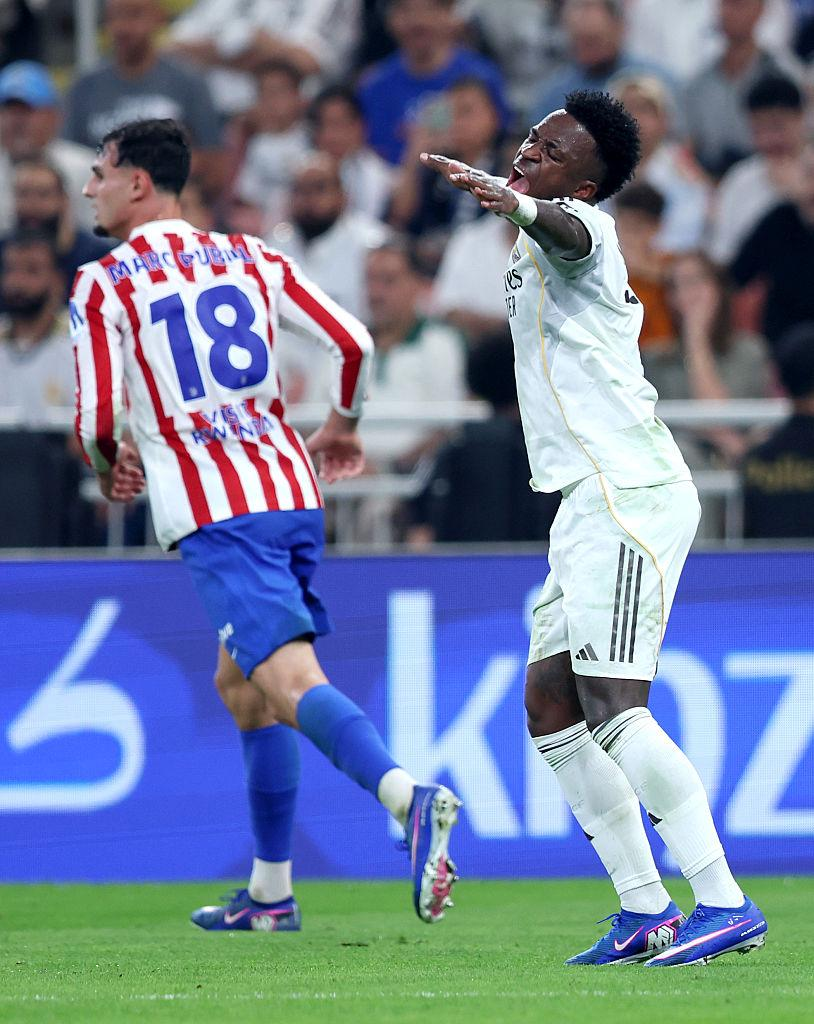
If the derby had a central narrative arc, it belonged to Vinícius Júnior.


Earlier in the season, the Brazilian forward endured criticism from sections of the Bernabéu crowd amid inconsistent results and the fallout from managerial changes. This match marked a decisive reversal.
Vinícius scored twice, delivering both technical precision and emotional clarity. His goals were not only pivotal to the result but symbolic of Real Madrid’s resurgence.
The Bernabéu, once critical, responded with renewed support—a reflection of both performance and perseverance.
Valverde’s Influence: The Midfield Engine
While Vinícius provided the headlines, Federico Valverde controlled the match’s rhythm.
The Uruguayan midfielder:
- Hit the post in the first half, signaling attacking intent
- Scored the decisive go-ahead goal in the second half
- Maintained transitional balance between defense and attack
Valverde’s performance underlined his growing importance within the squad. In the absence of key figures like Jude Bellingham and with Mbappé starting on the bench, he assumed responsibility and delivered.
Tactical Structure: Why the System Worked
Real Madrid’s setup offered several advantages:
1. Fluid Front Line
Without Mbappé fixed centrally, Vinícius and Díaz operated with positional freedom, stretching Atlético’s defensive block.
2. Midfield Control
Valverde’s advanced positioning created overloads, while maintaining defensive coverage when possession turned.
3. Squad Depth Utilization
The ability to leave a player of Mbappé’s caliber on the bench—and still win—demonstrated depth rarely matched in European football.
A Turning Point in the Title Race
The implications extend beyond the derby itself.
- Real Madrid closed the gap to league leaders Barcelona to just four points
- The victory reinforced their status as genuine title contenders
- Momentum now favors a team that appears tactically adaptable and psychologically resilient
Earlier in the season, a humiliating 5–2 defeat had exposed vulnerabilities. This result, combined with the elimination of Manchester City in the Champions League, suggests a significant correction in trajectory.
Atlético Madrid: Competitive but Marginally Short
Despite the loss, Atlético Madrid demonstrated:
- Clinical finishing through Lookman
- Structural discipline in midfield
- Consistent pressure in key phases
However, defensive lapses and Real Madrid’s attacking fluidity proved decisive. In a derby defined by fine margins, Atlético fell just short.
What This Match Signals About Modern Football
Arbeloa’s approach reflects a broader shift in elite football:
- Tactical flexibility outweighs rigid systems
- Squad rotation is essential in high-density schedules
- Data-informed decisions increasingly shape starting lineups
Benching a global superstar is no longer unthinkable—it is, in certain contexts, optimal.
What Comes Next: Reinforcements and Expectations
The anticipated return of Jude Bellingham introduces another dimension. A potential combination of:
- Mbappé’s attacking threat
- Vinícius’ form
- Valverde’s midfield control
- Bellingham’s versatility
creates a structurally balanced and highly dynamic unit.
If managed effectively, this core could define both domestic and European outcomes.
Conclusion: A Derby That Redefined Belief
Real Madrid’s 3–2 victory over Atlético Madrid was more than a result—it was a statement.
It validated tactical boldness, re-established Vinícius Júnior as a central figure, and reinforced the team’s capacity to compete at the highest level despite adversity.
In a season shaped by fluctuations, this derby may be remembered as the moment Real Madrid reasserted control—not just over their rivals, but over their own narrative.