





Nico O’Reilly: From Academy Prospect to Wembley Match-Winner
A Breakthrough Moment That Changed the Narrative
For much of the 2025–26 season, Nico O’Reilly had been quietly building momentum—earning trust within Manchester City’s system, adapting to positional demands, and gradually becoming a reliable option under Pep Guardiola.
- A Breakthrough Moment That Changed the Narrative
- The Final: A Game Defined by Precision and Punishment
- Performance Profile: Why O’Reilly Stood Out
- Development Path: From Academy to First-Team Contributor
- International Recognition and Expanding Influence
- The Guardiola Factor: System, Trust, and Adaptability
- Arsenal’s Collapse and the Role of Marginal Errors
- Broader Implications: A Player to Watch
- Future Outlook: Sustaining Momentum
- Conclusion: A Defining Arrival on the Big Stage
But on a decisive night at Wembley, that progression transformed into a defining statement.
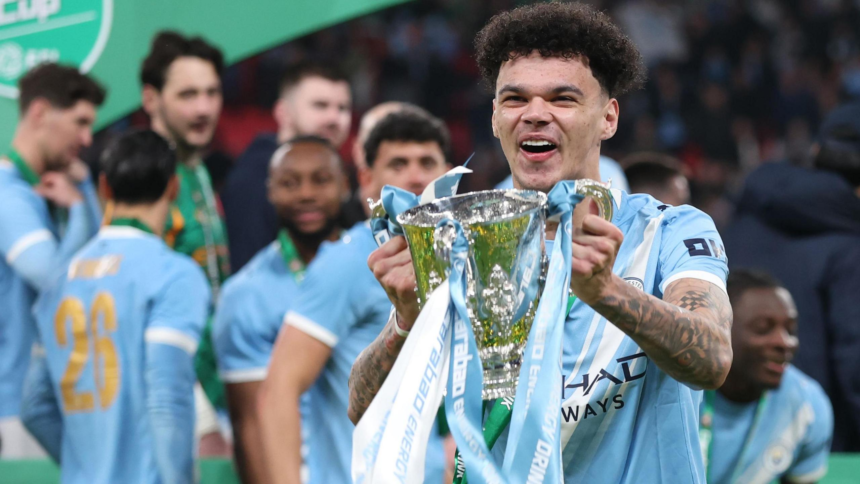
In the EFL Cup Final 2026, O’Reilly delivered a clinical brace that secured a 2–0 victory over Arsenal FC. The goals came within a four-minute window in the second half—an explosive sequence that shifted the entire dynamic of the match and ultimately decided the trophy.
This was not simply a good performance. It was a structural turning point in a young player’s career.



The Final: A Game Defined by Precision and Punishment
Tactical Context and Early Pressure
The final began with Arsenal applying structured pressing and early attacking intent. Within minutes, they created a high-quality chance through Kai Havertz, only to be denied by a remarkable triple save from City goalkeeper James Trafford.
Despite this early momentum, Arsenal struggled to convert territorial dominance into sustained threat. Their set-piece effectiveness—typically a defining feature—was notably absent, while City gradually absorbed pressure and recalibrated.



The Decisive Shift
The match pivoted on a moment that encapsulated both opportunity and error.
A cross from Rayan Cherki should have been routine for goalkeeper Kepa Arrizabalaga. Instead, the ball slipped through his hands, creating a high-probability rebound scenario. O’Reilly reacted instantly, converting from close range to open the scoring.
Four minutes later, the same player executed a second decisive action. Timing his run to the far post, he connected with a precise cross from Matheus Nunes and headed past Kepa again—effectively ending the contest.
The statistical detail is telling: O’Reilly’s only two touches inside the Arsenal penalty area resulted in two goals. From an efficiency standpoint, this represents elite-level decisiveness.



Performance Profile: Why O’Reilly Stood Out
Positional Intelligence
Operating nominally as a left-back, O’Reilly demonstrated advanced spatial awareness typically associated with attacking midfielders. His ability to arrive late into the penalty area—untracked—was central to both goals.
Decision-Making Under Pressure
Cup finals compress time and space. O’Reilly’s composure in high-leverage moments suggests a player with strong cognitive processing under stress—an attribute that distinguishes elite performers.
Physical Timing and Movement
The second goal highlighted his acceleration and timing. Beating Bukayo Saka to the far post required both anticipation and physical execution, indicating a well-developed off-ball profile.
Development Path: From Academy to First-Team Contributor
O’Reilly’s rise is rooted in a structured developmental pipeline within Manchester City’s academy system.
- Joined the club at age eight
- Progressed through youth levels to the Elite Development Squad
- 2022–23 season:
- 32 appearances
- 13 goals
- 14 assists
- U-18 Premier League title winner
- 2023–24: Academy Goal of the Year recipient
- 2024: First senior goal in a pre-season match against Barcelona
His transition into senior football accelerated during the 2025–26 campaign. Across 37 appearances, he has scored six goals—two of which carried decisive weight in a major final.
This trajectory reflects a player who has not only developed technically but adapted tactically across multiple roles.
International Recognition and Expanding Influence
O’Reilly’s performances have extended beyond club football.
He received a call-up to the England national team in 2025 and made his senior debut against Serbia in November of that year. While initially an unused substitute in earlier fixtures, his integration into the national setup signals recognition at the highest level.
Given his age—born 21 March 2005—he remains in an early developmental phase, yet already operates within elite competitive environments.
The Guardiola Factor: System, Trust, and Adaptability
Under Guardiola, positional flexibility is not optional—it is foundational. O’Reilly’s deployment at left-back, despite attacking instincts, reflects this tactical philosophy.
Guardiola’s reliance on him in a final suggests a high level of trust. The manager’s broader context is also relevant:
- The victory marked his fifth League Cup title
- It was his 15th major trophy with Manchester City
- The win followed a Champions League exit, restoring competitive momentum
O’Reilly’s contribution, therefore, was not isolated—it was embedded within a broader strategic recovery for the team.
Arsenal’s Collapse and the Role of Marginal Errors
While O’Reilly’s execution was decisive, the match also underscored the impact of individual errors at elite level.
Kepa’s mistake was not just technical—it was psychological. Following the error, Arsenal lost structural cohesion, allowing City to dominate the subsequent phase.
This aligns with a recurring theme in high-stakes matches: marginal lapses often produce disproportionate outcomes.
Broader Implications: A Player to Watch
O’Reilly’s performance carries implications across multiple dimensions:
For Manchester City
He provides depth and tactical flexibility, particularly in hybrid roles combining defensive positioning with attacking contribution.
For England
His profile aligns with modern international demands—versatility, technical quality, and positional intelligence. Early integration into the national team suggests long-term planning.
For the Competitive Landscape
His emergence adds another layer to City’s already complex squad structure, reinforcing their capacity to regenerate talent internally.
Future Outlook: Sustaining Momentum
Following the final, O’Reilly stated:
“(It’s an) unbelievable feeling to win a final and to beat this team. We know how good they are. We need to build on it now, it’ll give us momentum.”
The emphasis on “build on it” is critical. Breakthrough performances create expectation; sustaining that level determines trajectory.
With Manchester City aiming to close a nine-point gap in the Premier League and remain competitive across competitions, O’Reilly’s role may expand further.
Conclusion: A Defining Arrival on the Big Stage
Nico O’Reilly’s performance at Wembley was not an isolated highlight—it was a convergence of development, opportunity, and execution.
From academy progression to match-winning impact in a major final, his trajectory illustrates a model of modern player development: technically refined, tactically adaptable, and psychologically resilient.
The immediate outcome was a trophy. The longer-term significance is the emergence of a player capable of influencing elite-level matches.