




Jonas Urbig: Germany’s Next Goalkeeping Contender Emerges at a Defining Moment
A Breakthrough Narrative in Motion
In modern football, goalkeepers often mature later than outfield players. Yet every so often, a moment accelerates that timeline—an opportunity created by circumstance and seized through performance. For Jonas Urbig, that moment appears to have arrived.
- A Breakthrough Narrative in Motion
- From Backup to Spotlight: The Bayern Catalyst
- The National Team Call-Up: Timing and Strategy
- Internal Hierarchy: Where Urbig Stands
- Bayern’s Endorsement: Institutional Confidence
- Contextual Absence: Musiala and Squad Balance
- Tactical Fit: Why Urbig Matters
- The Competitive Landscape Ahead
- Future Outlook: A World Cup Trajectory?
- Conclusion: A Career Inflection Point
At just 22, the Bayern Munich goalkeeper has moved from relative obscurity to national-team relevance within weeks. A combination of injury disruptions, decisive performances, and strategic planning by Germany’s coaching staff has positioned him as one of the most intriguing emerging figures ahead of the 2026 World Cup cycle.
This is not merely a call-up story. It is a case study in timing, squad evolution, and the recalibration of Germany’s goalkeeping hierarchy.
From Backup to Spotlight: The Bayern Catalyst
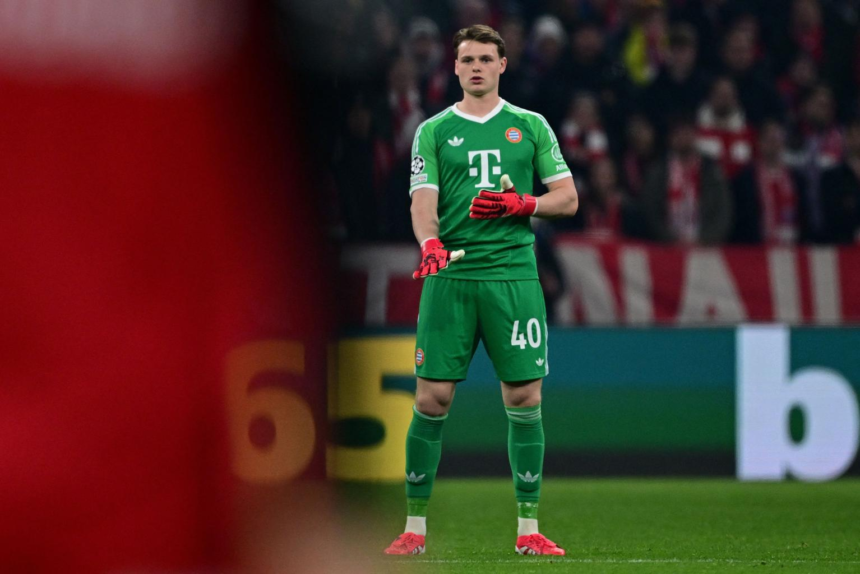
Urbig’s recent rise is inseparable from events at Bayern Munich. When Manuel Neuer—long regarded as one of the defining goalkeepers of his generation—was sidelined, the responsibility fell to Urbig.

Rather than merely filling a gap, he delivered.
In Bayern’s emphatic 4–1 UEFA Champions League victory over Atalanta Bergamo, Urbig produced a composed display that included crucial interventions to prevent an equalizer. His performance, rated 2.5, reflected both reliability and composure under pressure—key metrics in elite-level goalkeeping evaluation.
This was not an isolated performance. It was part of a short but impactful run that demonstrated:
-
Strong reflex shot-stopping
-
Positional discipline in high defensive lines
-
Confidence in distribution under pressure
These are precisely the attributes required in Bayern’s—and increasingly Germany’s—tactical framework.
The National Team Call-Up: Timing and Strategy
Germany head coach Julian Nagelsmann has made it clear that his squad selections are no longer experimental in isolation—they are prototypes for the 2026 World Cup.
The squad for the March friendlies will be “very similar” to the one for the 2026 World Cup.
This context transforms Urbig’s inclusion from a symbolic reward into a strategic evaluation phase.

According to reports, Urbig—alongside Bayern teammate Lennart Karl—is set for his first senior national team call-up for matches against Switzerland (March 27) and Ghana (March 30).
Interestingly, Urbig himself appeared almost detached from the announcement:
“I haven’t looked at my phone yet… Well, I was told about it a little while ago, briefly.”
The understated reaction contrasts sharply with the significance of the moment.
Internal Hierarchy: Where Urbig Stands
Despite the excitement, Germany’s goalkeeping hierarchy remains defined—for now.
Oliver Baumann is expected to retain the number one role for the upcoming fixtures. This indicates that Urbig’s immediate function is not to start, but to:
-
Integrate into the national team environment
-
Undergo tactical and psychological assessment
-
Build familiarity with Nagelsmann’s system
However, the long-term implications are more consequential.
Germany is transitioning away from an era dominated by figures like Neuer. The pathway is opening for a new generation, and Urbig is now firmly within that pipeline.
Bayern’s Endorsement: Institutional Confidence
Support from Bayern Munich’s leadership further underscores Urbig’s growing stature.
Sporting director Max Eberl reacted positively to the reports:
“If Julian is nominated and names like that come up, then we’re delighted.”
While Eberl stopped short of confirming the selection, the tone reflects institutional confidence—a critical factor for any young player navigating elite football environments.
Contextual Absence: Musiala and Squad Balance
Urbig’s call-up also occurs alongside notable absences, particularly Jamal Musiala.
The Bayern playmaker is expected to miss the upcoming international window due to ongoing recovery from a foot issue. As explained internally:
-
Musiala will not travel with the national team
-
The focus is on full recovery post-international break
This decision highlights a broader theme in Germany’s squad management: prioritizing long-term readiness over short-term participation.
Within that framework, Urbig’s inclusion aligns with a forward-looking strategy rather than reactive selection.
Tactical Fit: Why Urbig Matters
From a technical perspective, Urbig’s profile aligns with modern goalkeeping requirements:
1. Sweeper-Keeper Capabilities
Germany continues to favor a proactive defensive structure. Urbig has shown comfort operating outside the box—an essential trait in high defensive lines.
2. Ball Distribution
Bayern’s system demands precision in build-up phases. Urbig’s ability to play under pressure enhances his tactical value.
3. Psychological Composure
His performances suggest a capacity to handle high-stakes environments—an often overlooked but critical attribute in international football.
The Competitive Landscape Ahead
Urbig’s path is promising, but not uncontested.
Germany’s goalkeeper pool includes:
-
Established figures maintaining short-term control
-
Emerging talents competing for long-term roles
The next phase of evaluation will likely focus on:
-
Training camp performance
-
Adaptation to international tempo
-
Decision-making under elite pressure
In essence, the call-up is an entry point, not a conclusion.
Future Outlook: A World Cup Trajectory?
Nagelsmann’s comments provide the clearest signal of intent: the current selections are building toward USA, Canada, and Mexico 2026.
For Urbig, this creates a defined trajectory:
-
Initial integration (March friendlies)
-
Extended squad involvement (2026 preparation phase)
-
Potential tournament inclusion (World Cup squad)
Whether he becomes a starter or a squad option will depend on consistency, adaptability, and competition outcomes.
Conclusion: A Career Inflection Point
Jonas Urbig’s emergence is not a sudden breakthrough—it is the convergence of preparation, opportunity, and strategic timing.
From stepping in for Manuel Neuer at Bayern Munich to entering Germany’s national team conversation, his trajectory reflects both individual merit and systemic transition within German football.
The coming months will determine whether this moment remains a promising episode or evolves into a defining chapter. What is already clear, however, is that Germany’s next generation of goalkeepers has found a compelling new contender.