






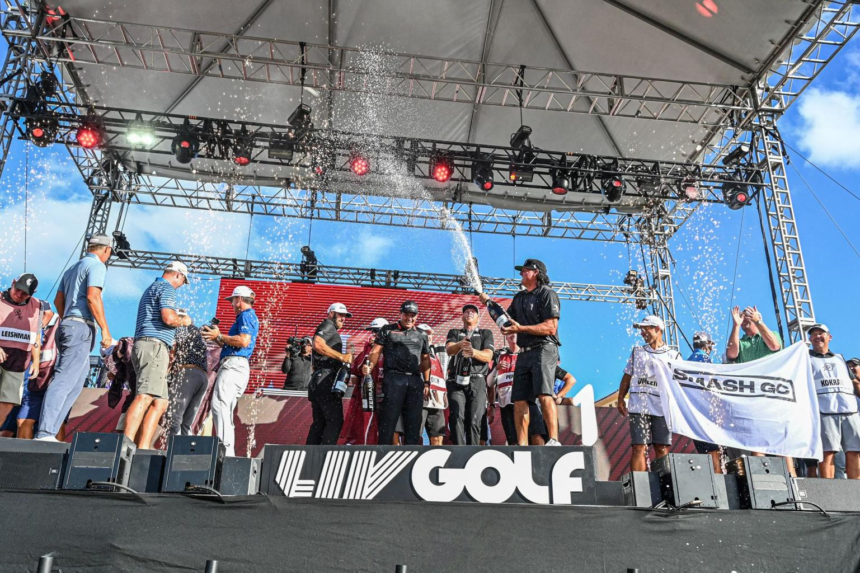
LIV Golf’s Expanding Influence: Inside the New Era of Global Golf
A Different Kind of Golf Stage
In just a few years, LIV Golf has shifted from a disruptive entrant to a defining force in the global golf ecosystem. Its model—shorter tournaments, team-based competition, and entertainment-driven presentation—has challenged long-standing conventions while drawing new audiences into the sport.
Nowhere is that transformation more visible than in events like the 2026 South African stop, where sport, celebrity, and culture intersect in a way traditional golf rarely attempted.
Steyn City Sets the Scene
At The Club at Steyn City, the LIV Golf South Africa event opened with a pro-am that reflected the league’s broader identity: cross-sport collaboration and fan engagement.
On Wednesday, professional golfer Lucas Herbert teamed up with two of South Africa’s most recognizable rugby figures—Bryan Habana and Handré Pollard—for the inward nine holes ahead of the tournament.


Herbert’s reaction captured the tone of the event. He described his playing partners as “South African Rugby Royalty,” a phrase that underscores how LIV Golf blends elite sport with national icons from outside the game.
A Cross-Sport Showcase
The pro-am format serves a clear purpose: it bridges audiences. Golf fans encounter stars from rugby and cricket, while followers of those sports are introduced to golf in a more accessible setting.



A second grouping reinforced that approach. Graeme Smith and Schalk Burger joined professional golfers including Branden Grace—a member of the all-South African team Southern Guards—and Marc Leishman of Ripper GC.
The structure was deliberate:
-
Front nine: played alongside one professional grouping
-
Back nine: rotated with another LIV team player
This rotational format increases interaction, creating multiple touchpoints between amateurs, professionals, and fans.
What the Pro-Am Achieves
The pro-am is not simply ceremonial. It performs several strategic functions within the LIV Golf ecosystem:

1. Audience Expansion
By integrating figures like Habana, Pollard, Smith, and Burger, the event taps into rugby and cricket fanbases—two dominant sporting audiences in South Africa.
2. Brand Localization
Aligning with national sporting heroes helps LIV Golf embed itself within local culture rather than appearing as an external product.
3. Commercial Value
High-profile pairings elevate broadcast appeal and sponsor visibility, reinforcing LIV’s entertainment-first positioning.
4. Player Accessibility
Fans gain rare proximity to professional golfers in a relaxed setting, reducing the traditional distance between athlete and audience.
The LIV Golf Model in Context
Unlike conventional tours, LIV Golf emphasizes:
-
Team-based competition alongside individual scoring
-
Shorter tournament formats
-
High-energy presentation, including music and fan zones
-
Global event rotation across emerging and established markets
The South African event illustrates how these elements translate on the ground. The presence of teams like Southern Guards and Ripper GC reflects the league’s franchise-style structure, which contrasts with the individual-centric tradition of golf.
Cultural Convergence on the Fairway
What stands out most is the cultural layering. Rugby, cricket, and golf—three sports with deep roots in South Africa—converge within a single event. The result is less a standard tournament and more a multi-sport showcase.
This convergence also signals a broader shift in sports consumption. Audiences are no longer confined to one discipline; they engage with personalities, narratives, and shared experiences across sports.
Looking Ahead: What This Means for Golf
The LIV Golf South Africa event offers a preview of where the sport may be heading:
-
Greater entertainment integration: Golf events increasingly resemble live spectacles rather than purely competitive environments.
-
Cross-industry collaboration: Expect more partnerships with athletes from other sports and even entertainment sectors.
-
Global market focus: Expansion into regions like Africa reflects a deliberate strategy to grow beyond traditional golf strongholds.
At the same time, the model raises ongoing questions about sustainability, competitive balance, and the long-term relationship with established tours. Those debates remain unresolved—but the momentum behind LIV Golf is difficult to ignore.
Conclusion: A Redefined Golf Experience
The pro-am at Steyn City was more than a warm-up event. It was a microcosm of LIV Golf’s broader strategy: blending elite competition with cultural relevance, star power, and audience engagement.
By bringing together figures like Lucas Herbert, Bryan Habana, Handré Pollard, Graeme Smith, and Schalk Burger, the event demonstrated how golf can evolve into a more inclusive and commercially dynamic product.
Whether this approach reshapes the sport permanently is still unfolding. What is clear, however, is that LIV Golf has already altered the expectations of what a golf event can be.