





Bryson DeChambeau and the Energy of a New Golf Frontier
A Defining Moment for Modern Golf
When Bryson DeChambeau stepped onto the fairways of Steyn City in Johannesburg, the moment felt larger than a typical tournament round. This was not just another stop on the LIV Golf calendar—it was a test of golf’s global reach, its evolving identity, and its ability to connect with new audiences.
By the end of Thursday’s opening round at LIV Golf South Africa, one thing was clear: the experiment worked. And DeChambeau stood at the center of it.
The Scene: A Tournament Fueled by Anticipation
For months, LIV Golf promoted its first African event as something distinct. Still, even insiders acknowledged the uncertainty. Golf events often promise more than they deliver—ticket sales can surge, but atmosphere is harder to guarantee.
This time, the numbers told a different story.
-
90,000 tickets sold before the tournament concluded
-
Demand rivaled LIV’s most successful event in Australia
-
An additional 18 holes were added, allowing more ticket sales—and those tickets moved quickly
The crowds at the Club at Steyn City validated the hype. Spectators lined the course, followed groups across all 18 holes, and surged toward players after rounds.
At the center of that energy was DeChambeau.
DeChambeau’s Round: Performance Meets Presence
On the course, DeChambeau delivered immediately. He secured a share of the first-round lead, continuing strong form after his recent victory in Singapore.
But his influence extended far beyond his scorecard.
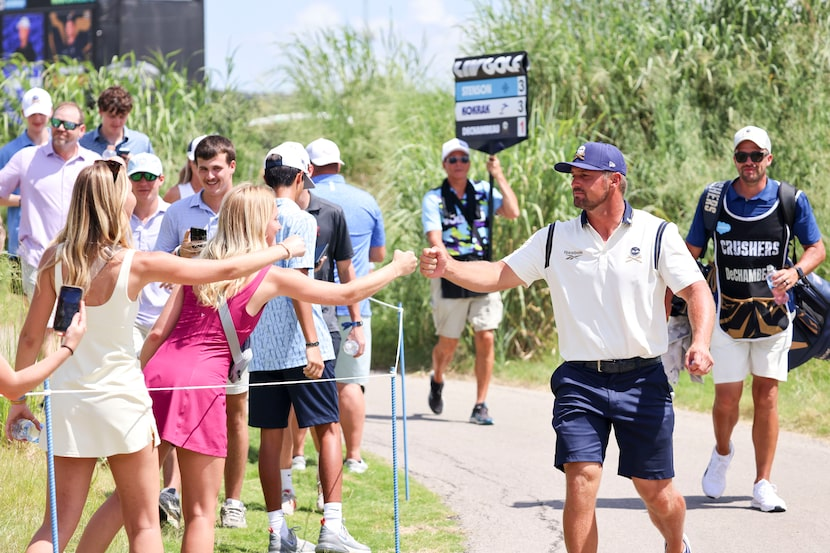
After finishing his round, DeChambeau made a promise: he would sign autographs for every fan waiting. What followed was less a routine post-round interaction and more a prolonged engagement with an enthusiastic crowd.
For over 30 minutes, he signed:
-
Gloves, hats, and flags
-
Umbrellas and cases
-
Backpacks and shirts
-
Even shoes handed over by fans balancing on one foot
He later explained that signing autographs “re-energizes” him—a statement that became visible in real time as he stayed long after most players would have left.
The Crowd Effect: When Golf Feels Like a Stadium Sport
The South African crowd did not behave like a passive gallery. It behaved like a live sporting audience—engaged, vocal, and emotionally invested.
Fans didn’t just watch DeChambeau:
-
They rushed him after shots, asking for selfies
-
They followed entire rounds across a demanding, hilly course
-
They created a constant hum of noise typically associated with team sports
DeChambeau himself acknowledged the scale of the experience:
“What an environment. I mean, this is what all of us players saw LIV Golf being and the potential of it … South Africa showed [up] today, and it’s only Thursday.”
That remark captured more than appreciation—it pointed to a vision LIV Golf has pursued since its inception: transforming golf into a more immersive, fan-driven spectacle.
Local Heroes and Shared Emotion
While DeChambeau drew global attention, the emotional core of the event belonged to South Africa’s own players.
The Southern Guards team, featuring:
-
Louis Oosthuizen
-
Charl Schwartzel
-
Dean Burmester
-
Branden Grace
rose to the occasion with a combined 18-under-par performance, leading the team competition by one stroke.
Branden Grace fired a seven-under 64, placing himself one shot off the individual lead alongside DeChambeau and Charles Howell III.
But beyond the scores, the emotional impact stood out.
Oosthuizen described the moment with visible emotion:
“I was tearing up a little bit.”
Schwartzel, battling back pain, echoed that intensity:
“Very few times you get to experience in your career where your hair stands up and you get these needles going through your body.”
For Burmester, the day represented a career peak—what he called the “pinnacle.”
The crowd’s support played a direct role. Schwartzel admitted he might not have completed the round without it.
The Physical Toll and Competitive Context
The tournament arrived at a demanding point in the schedule.
-
Players had already competed in Hong Kong and Singapore
-
Travel had been continuous, moving westward across continents
-
The Masters was just 13 days away
Despite fatigue, the level of play remained high. Schwartzel’s situation illustrated the strain:
-
He experienced severe back pain
-
Underwent multiple treatments, including acupuncture and medication
-
Considered withdrawing before being encouraged to compete
His performance—shooting 66—highlighted both resilience and the motivational effect of a supportive crowd.
LIV Golf’s Strategy: Global Expansion Under Pressure
LIV Golf’s expansion model has been uneven. Some events have thrived; others have struggled to generate sustained engagement.
South Africa, however, represents a case study in successful execution.
Key elements included:
-
Strong pre-event marketing
-
High ticket demand from announcement in July
-
A venue capable of handling large, mobile crowds
-
A mix of global stars and local heroes
The decision to add extra rounds—effectively increasing inventory—demonstrated confidence in demand, and the sales validated that decision.
This success also reinforces LIV’s broader thesis: that golf can grow by entering new markets with high enthusiasm but historically limited access to elite tournaments.
DeChambeau’s Role in Golf’s Evolution
DeChambeau has long been one of golf’s most polarizing and innovative figures.
Known for:
-
His scientific approach to the game
-
Emphasis on power and distance
-
Willingness to challenge tradition
He now occupies a different role—a bridge between elite performance and fan engagement.
At Steyn City, he wasn’t just competing; he was participating in the spectacle:
-
Engaging directly with fans
-
Taking selfies mid-round
-
Extending post-round interactions far beyond expectations
This behavior aligns closely with LIV’s entertainment-driven model, where player accessibility is part of the product.
What This Means for Golf’s Future
The success of LIV Golf South Africa carries broader implications:
1. Emerging Markets Matter
The scale of turnout demonstrates untapped demand in regions outside traditional golf strongholds.
2. Fan Interaction Is No Longer Optional
Modern audiences expect proximity, access, and personality—not just performance.
3. Format Innovation Can Drive Growth
Additional rounds and flexible scheduling increased revenue and attendance.
4. Player Identity Is Expanding
Athletes like DeChambeau are no longer just competitors—they are central to the entertainment value of the sport.
Conclusion: A Week That May Reshape Expectations
Thursday at Steyn City was not simply an opening round. It was a demonstration of what golf can look like when energy, access, and global ambition align.
Bryson DeChambeau’s performance—both on and off the course—captured that shift. He led the leaderboard, but more importantly, he led the experience.
With the Masters approaching and LIV Golf continuing its global push, the question is no longer whether new formats can work. The question is how quickly the rest of the sport will adapt.