






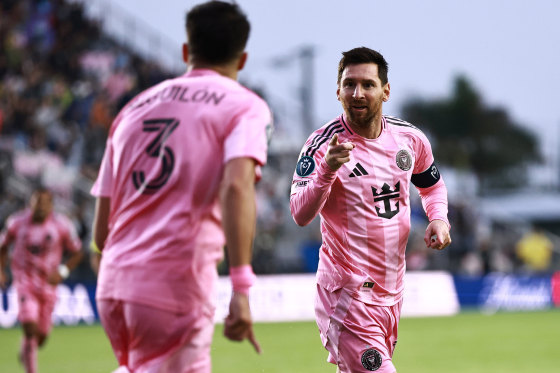
Concacaf Champions Cup: Messi’s 900th Goal Overshadowed by Inter Miami’s Exit
A Night of History and Heartbreak
The CONCACAF Champions Cup delivered one of its most dramatic nights yet on March 18, 2026—an evening that perfectly captured the tournament’s dual nature: historic individual brilliance and unforgiving team consequences.
- A Night of History and Heartbreak
- What the Concacaf Champions Cup Represents
- The Match That Defined the Moment
- The Deciding Factor: Away Goals Rule
- A Bittersweet Milestone for Messi
- Inter Miami’s Ambition Falls Short
- The Stadium Farewell
- What This Means for the Tournament
- The Broader Impact: Football, Culture, and Narrative
- What Comes Next
- Conclusion
At the center of it all was Lionel Messi, who reached an extraordinary milestone—his 900th career goal—during a Round of 16 clash between Inter Miami CF and Nashville SC. Yet, despite the magnitude of that achievement, the night ended in disappointment for Miami, who were eliminated from the competition.
What the Concacaf Champions Cup Represents
The Concacaf Champions Cup is the premier club competition in North America, Central America, and the Caribbean. It serves as the region’s equivalent to Europe’s UEFA Champions League, bringing together top clubs from domestic leagues to compete for continental supremacy.
For teams like Inter Miami, the tournament carries more than prestige. It represents:


-
A pathway to global recognition
-
Qualification for international competitions
-
A benchmark of sporting ambition
In 2026, Miami entered the tournament with a clear objective: to win it.
The Match That Defined the Moment
Early Promise: Messi Strikes First
The second leg of the Round of 16, played at Inter Miami CF Stadium (formerly Chase Stadium), began with immediate intensity. Within just seven minutes, Messi delivered a moment that would echo across the football world.



Receiving an assist from Sergio Reguilón, the Argentine legend controlled the ball inside the area and fired a precise left-footed shot into the net. The goal was not just decisive—it was historic.
900 career goals.
The milestone placed Messi among an elite group of players and reinforced his enduring influence at 38 years old.
Tactical Tension and Missed Opportunities
Despite the early lead, Inter Miami struggled to maintain control. Coach Javier Mascherano opted for a 4-4-2 system, a decision that drew scrutiny due to its lack of midfield dominance.



Key issues emerged:
-
Limited offensive support for Messi
-
Difficulty controlling possession in midfield
-
Missed chances to extend the lead
Mascherano later acknowledged the team’s shortcomings:
“It’s a very sad night, a night of great disappointment. We were hoping to advance in the competition.”
He added:
“We had chances to score more goals, especially in the first half… I have nothing to reproach the players for. They did everything they could, and I am clearly responsible for this elimination.”
The Turning Point: Nashville Responds
As the match progressed, Nashville SC grew into the game. Their persistence paid off in the 74th minute when Argentine winger Cristian Espinoza capitalized on a chaotic defensive sequence.
A deflected shot and a failed clearance from goalkeeper Dayne St. Clair left the ball perfectly positioned for Espinoza, who volleyed it into the net.
That single goal changed everything.
The Deciding Factor: Away Goals Rule
With the first leg ending 0–0 in Nashville and the second leg finishing 1–1, the tie was level on aggregate. However, Nashville advanced due to the away goals rule.
This rule—often controversial—rewards teams for scoring goals on the road, emphasizing tactical discipline in two-legged ties.
For Inter Miami, it meant elimination despite not losing either match.
A Bittersweet Milestone for Messi
Messi’s 900th goal became one of the defining narratives of the tournament. Achieved at 38 years and 9 months, and in his 1,142nd match, the milestone underscored his longevity and consistency.
Global reactions reflected the scale of the achievement:
-
“Lionel Messi scores his 900th goal!”
-
“Another record in Leo Messi’s unbeatable career.”
-
“The legend continues…”
Yet the context made it bittersweet. The goal gave Miami an early advantage—but not progression.
Inter Miami’s Ambition Falls Short
Inter Miami’s elimination carries broader implications for the club’s trajectory.
A Season Built on Continental Success
After winning their first MLS title in 2025, Miami invested heavily to compete at a higher level:
-
Sergio Reguilón
-
Germán Berterame
-
Permanent signing of Rodrigo De Paul
The Concacaf Champions Cup was identified as the club’s primary objective for 2026.
A Pattern of Near Misses
This exit continues a trend:
-
2024: Eliminated in the quarterfinals
-
2025: Eliminated in the semifinals
-
2026: Eliminated in the Round of 16
Despite star power and financial backing, continental success remains elusive.
The Stadium Farewell
The match also marked a symbolic moment: a farewell to Inter Miami’s longtime home stadium.
Playing under heavy rain, the team’s exit added emotional weight to the occasion. The club is set to move to a new venue, Nu Stadium, in early April.
The combination of elimination and transition gave the night a definitive sense of closure.
What This Means for the Tournament
For Nashville SC, progression to the quarterfinals opens new possibilities. They will face either Philadelphia Union or Club América, two formidable opponents.
For the competition itself, the match reinforced several themes:
-
The increasing competitiveness of MLS clubs
-
The growing global attention driven by players like Messi
-
The unpredictable nature of knockout football
The Broader Impact: Football, Culture, and Narrative
The Concacaf Champions Cup continues to evolve as a cultural and sporting platform.
Global Visibility
Messi’s presence has elevated the tournament’s international profile, drawing attention from Europe, South America, and beyond.
Competitive Balance
Results like this highlight a narrowing gap between clubs, where tactical discipline can outweigh star power.
Storytelling in Football
This match offered a compelling narrative:
-
A historic individual achievement
-
A collective team failure
-
A reminder that football is ultimately decided by margins
What Comes Next
For Inter Miami:
-
Refocus on the MLS season
-
Pursue domestic dominance
-
Reassess tactical structure
For Messi:
-
Continue the pursuit of 1,000 career goals
-
Maintain influence ahead of the 2026 FIFA World Cup
For the Concacaf Champions Cup:
-
Build momentum as a globally relevant competition
-
Deliver more high-stakes, high-profile fixtures
Conclusion
The Concacaf Champions Cup Round of 16 clash between Inter Miami and Nashville SC encapsulated the essence of football: triumph and disappointment coexisting in a single moment.
Lionel Messi’s 900th goal will be remembered as a historic milestone. Yet, the broader narrative belongs to Nashville’s progression and Miami’s elimination.
In elite competition, individual brilliance can illuminate the stage—but it does not guarantee advancement.