




Nantes vs Strasbourg: A Late Twist That Defined the Night
A Game That Refused to Settle
On the evening of Sunday, 22 March 2026, at the Stade de la Beaujoire – Louis Fonteneau, what began as a tightly contested Ligue 1 fixture evolved into one of the most dramatic finishes of the season. Nantes and Strasbourg delivered a match that oscillated between control and chaos, ultimately ending in a 3–2 victory for Strasbourg—a result sealed in the dying seconds.
- A Game That Refused to Settle
- Early Control: Nantes Strike First
- Strasbourg’s Response Before the Break
- Nantes Regain the Lead—but Momentum Shifts
- Tactical Adjustments and Turning Point
- Panichelli Changes the Narrative
- Stoppage-Time Drama
- Statistical Breakdown: Control vs Efficiency
- Key Individuals
- What This Result Means
- Conclusion: A Match Defined by Margins
At half-time, the contest stood balanced at 1–1. By full-time, it had transformed into a narrative about resilience, tactical persistence, and decisive moments under pressure.
Early Control: Nantes Strike First
The match opened with Nantes asserting themselves aggressively. Their intent translated into an early breakthrough in the 6th minute when Dehmaine Tabibou found the net, finishing from close range after being set up by Matthis Abline.
That early goal reflected Nantes’ initial efficiency. Despite ultimately having only 37.2% possession, they were clinical in transitions and direct attacks. Their early dominance forced Strasbourg into reactive play, with Nantes generating multiple chances in the opening phase.


Yet, the underlying numbers hinted at a different trajectory.
Strasbourg’s Response Before the Break
As the first half progressed, Strasbourg gradually imposed themselves through superior ball retention and structured buildup. They completed 576 passes compared to Nantes’ 327, with a significantly higher pass accuracy of 90.6%.


That control paid off just before the interval. In stoppage time of the first half (45+2’), Maxi Oyedele equalized, finishing a move assisted by Sam Amo-Ameyaw. The timing was critical—it neutralized Nantes’ early advantage and shifted the psychological balance heading into the second half.
Nantes Regain the Lead—but Momentum Shifts
The second half began with renewed urgency from both sides. Nantes struck again in the 53rd minute through Matthis Abline, who converted a fast-break opportunity assisted by Chidozie Awaziem.
At 2–1, Nantes appeared to have regained control. Their attacking output was notable:
- 13 total shots (9 on target)
- 2 shots hitting the woodwork
- 17 touches inside the opposition box
However, beneath the surface, Strasbourg continued to dominate structurally:


- 62.8% possession
- 81 successful final-third passes (compared to Nantes’ 42)
- 30 touches inside the opposition box
The match was increasingly tilting toward Strasbourg, even while Nantes held the lead.
Tactical Adjustments and Turning Point
The defining moment came not from a single play, but from a series of calculated substitutions by Strasbourg in the second half.
The introduction of Joaquín Panichelli proved decisive. Entering as a substitute, he became the focal point of Strasbourg’s attacking resurgence.
Strasbourg also reshaped their midfield and attacking transitions by introducing Gessime Yassine and Abdoul Ouattara, increasing tempo and penetration in the final third.
The effect was immediate.
Panichelli Changes the Narrative
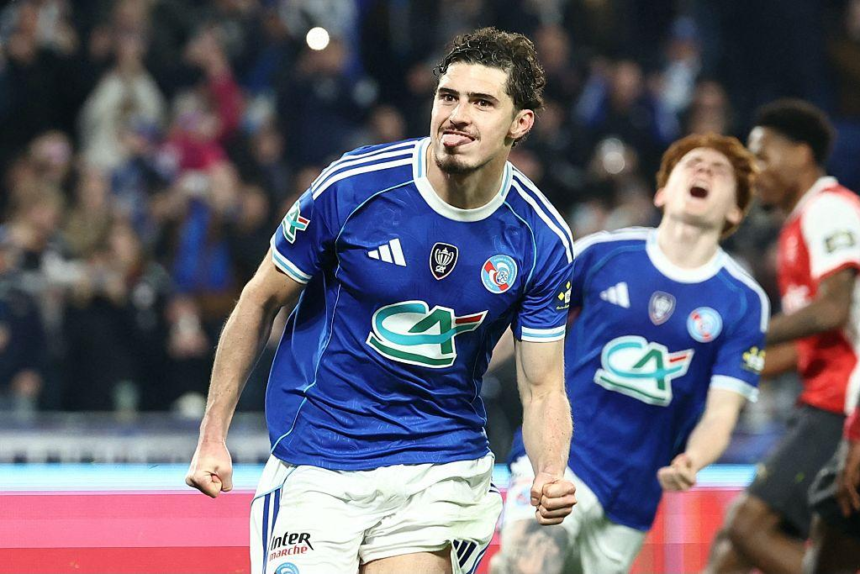
In the 78th minute, Joaquín Panichelli scored the equalizer, finishing from the center of the box after an assist from Gessime Yassine. At 2–2, the momentum had fully shifted.
From that point onward, Strasbourg applied sustained pressure:
- Multiple late attempts forced saves from Nantes goalkeeper Anthony Lopes
- A sequence of corners and attacking phases pinned Nantes deep
- Defensive errors and fatigue began to emerge in Nantes’ structure
Then came the decisive moment.
Stoppage-Time Drama
Deep into stoppage time (90+2’), Strasbourg completed the comeback. Following a set-piece situation and a sequence of attempts, Panichelli struck again from close range to make it 3–2.
The goal encapsulated the match:
- Persistent pressure
- Second-ball awareness
- Clinical finishing at a critical moment
Despite Nantes’ defensive efforts—recording 19 tackles and 18 clearances—they were unable to withstand Strasbourg’s late surge.
Statistical Breakdown: Control vs Efficiency
A closer look at the match statistics reveals a clear contrast in styles:
Strasbourg’s Dominance
- Possession: 62.8%
- Pass accuracy: 90.6%
- Final-third passes: 81
- Touches in opposition box: 30
Nantes’ Efficiency
- Shots: 13 (equal to Strasbourg)
- Shots on target: 9 (equal)
- Woodwork hit: 2
- Tackles: 19 (defensive intensity)
Despite equal shooting numbers (13–13) and identical shots on target (9–9), Strasbourg’s superior control and territorial dominance ultimately dictated the outcome.
Key Individuals
Joaquín Panichelli (Strasbourg)
The defining figure of the match. His brace (78’, 90+2’) transformed the game and secured all three points.
Matthis Abline (Nantes)
A constant attacking threat, contributing both a goal and an assist. His involvement in early phases kept Nantes competitive.
Maxi Oyedele (Strasbourg)
Delivered the crucial equalizer before half-time, ensuring Strasbourg remained in contention.
Anthony Lopes (Nantes)
Made multiple saves (Nantes recorded 6 goalkeeper saves), delaying Strasbourg’s breakthrough but ultimately unable to prevent the late goals.
What This Result Means
From a broader perspective, this match highlights several important dynamics in Ligue 1:
1. The Value of Possession-Based Control
Strasbourg’s ability to dictate tempo and maintain high pass accuracy allowed them to stay composed even when trailing.
2. Impact of Substitutions
The introduction of Panichelli and others demonstrates how tactical adjustments can redefine a match.
3. Late-Game Resilience
Scoring twice after the 75th minute reflects both physical endurance and mental focus—key traits for teams aiming to climb the table.
Conclusion: A Match Defined by Margins
Nantes vs Strasbourg was not merely a five-goal encounter; it was a case study in contrasting approaches. Nantes relied on efficiency and directness, while Strasbourg leaned on structure, control, and persistence.
In the end, the latter prevailed.
Strasbourg’s 3–2 victory was built on patience, tactical adaptation, and decisive execution in critical moments. For Nantes, the match will be remembered as an opportunity lost—one where early advantages could not be sustained against a more controlled opponent.