






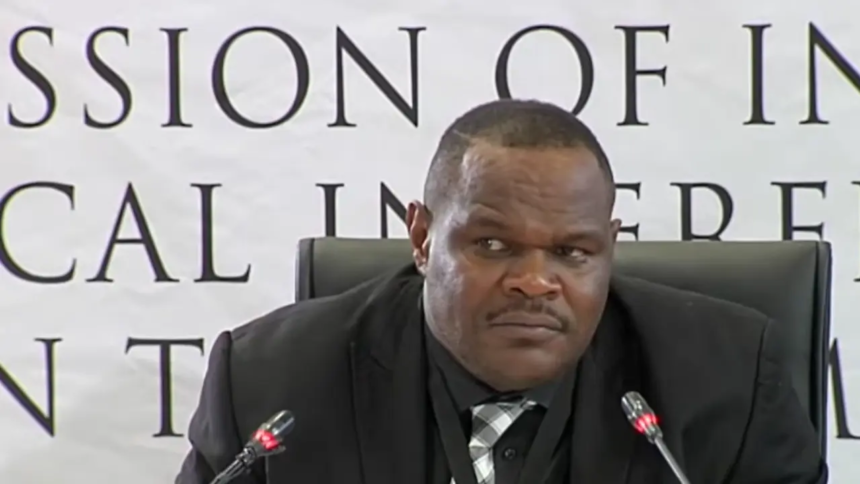
Steve Motsumi: Inside the Shadowy Power Networks Under Scrutiny
A Name That Emerged From Fear Into Public View
For months, he was referred to only in whispers—“Mr So-and-so,” “the dangerous man.” Now, the name Steve Motsumi sits at the center of one of the most consequential investigations into alleged corruption within the South African Police Service (SAPS).
- A Name That Emerged From Fear Into Public View
- From Private Businessman to Public Controversy
- Testimony That Redefined the Narrative
- Alleged Links to the “Big Five” Cartel
- The Role of Aliases and Hidden Identity
- Economic Influence: Taxi Industry and Security Networks
- Extortion Allegations and Violent Economy Links
- A Climate of Fear Within Law Enforcement
- The Broader Implications for South Africa
- What Comes Next?
- Conclusion
The proceedings of the Madlanga Commission of Inquiry have drawn attention to a figure whose influence, according to testimony, extends far beyond legitimate business. What has emerged is not just a profile of a businessman, but a portrait of a suspected power broker operating at the intersection of commerce, law enforcement, and organized crime.
From Private Businessman to Public Controversy
Until recently, Motsumi maintained a low public profile. Based in Johannesburg, he reportedly lived in a heavily secured estate in the northern suburbs, managing business interests that included construction, money lending, and the taxi industry.
His operations, by all accounts, were deliberately discreet. Family life and alleged parallel dealings were kept out of public scrutiny. That changed when multiple witnesses began identifying him during commission hearings as a figure associated with alleged police corruption and organized criminal networks.



The sudden shift—from obscurity to central figure—was not accidental. It followed mounting testimony suggesting his name was already widely known within certain circles, but rarely spoken openly due to fear.
Testimony That Redefined the Narrative
A turning point came through the testimony of Fannie Nkosi, also referred to as Witness F. Nkosi described his role as a conduit between Motsumi and Shadrack Sibiya, a suspended senior police official.



According to Nkosi’s account, he:
-
Facilitated meetings between Sibiya and Motsumi
-
Forwarded confidential SAPS documents and messages
-
Acted as an intermediary in sensitive communications
This testimony raised a critical concern: that Motsumi may have had access to internal police intelligence through high-ranking officials. Nkosi further admitted to sharing confidential reports, including those related to a R360 million contract, with Motsumi.
The implications are structural rather than incidental. If accurate, these actions suggest a breakdown of institutional safeguards within SAPS, where sensitive information may have been accessible to external actors.
Alleged Links to the “Big Five” Cartel
At the center of the allegations is Motsumi’s supposed connection to a group referred to as the “Big Five”—a network accused of orchestrating violence, manipulating investigations, and exerting influence across key economic sectors.



Names associated with this alleged cartel include:
-
Joseph Sibanyoni
-
Vusimusi Matlala
-
Katiso Molefe
-
Jotham Msibi
Motsumi is described in testimony as one of the central figures within this group, with influence spanning both the taxi industry and broader criminal networks.
While no formal judicial conclusions have been reached, the repeated references across witnesses have elevated the seriousness of these claims.
The Role of Aliases and Hidden Identity
Another layer of complexity lies in Motsumi’s alleged use of multiple aliases, including:
-
“Mthakathi”
-
“RR”
-
“Mswazi”
These identities surfaced in testimonies and communications, suggesting a deliberate effort to obscure involvement in certain dealings. Early in the commission, witnesses avoided naming him directly, citing fear of retaliation—a factor that shaped how evidence was initially presented.
In January 2026, Mbuyiseli Madlanga ordered that Motsumi’s name be publicly disclosed, marking a decisive moment in the inquiry.
Economic Influence: Taxi Industry and Security Networks
Motsumi’s alleged influence is not limited to informal networks. Testimony points to his involvement in:
-
The taxi industry—an economically and socially significant sector in South Africa
-
Private security operations—potentially offering both protection and leverage
This combination is particularly notable. The taxi industry has long been associated with both legitimate transport operations and, at times, violent competition. Coupled with private security interests, it creates a structure capable of exerting both economic pressure and on-the-ground influence.
Extortion Allegations and Violent Economy Links
One of the more serious claims involves an alleged extortion case connected to a chrome mine in Brits, where testimony suggested a demand for 50% of the mine’s chrome output.
This allegation, linked through testimony involving Richard Shibiri, underscores the scale of economic control allegedly sought by networks tied to Motsumi.
Such claims, if substantiated, point to a system where criminal influence intersects directly with resource extraction and industrial activity.
A Climate of Fear Within Law Enforcement
Multiple witnesses described a climate of intimidation surrounding Motsumi. The reluctance to name him publicly was not procedural—it was driven by perceived personal risk.
Another witness, Lesetja Senona, indicated that Motsumi was connected to a network within SAPS itself. This reinforced concerns that criminal elements may not just influence law enforcement from outside, but operate within its structures.
The broader implication is systemic vulnerability: when internal actors collaborate with external networks, oversight mechanisms become significantly weakened.
The Broader Implications for South Africa
The case of Steve Motsumi is not simply about one individual. It reflects deeper structural questions:
-
How far has criminal infiltration penetrated law enforcement?
-
To what extent can economic sectors be influenced by informal power networks?
-
What safeguards failed to prevent alleged information leaks at senior levels?
The Madlanga Commission’s mandate is to address these questions. Its findings could have lasting consequences for institutional reform, public trust, and accountability within SAPS.
What Comes Next?
As hearings continue, more testimony is expected to clarify—or complicate—the narrative around Motsumi’s alleged role.
At present, the picture remains incomplete. The commission has surfaced significant allegations, but formal legal conclusions will depend on further investigation, corroboration, and potential prosecution.
What is already clear is that Motsumi’s name has shifted from obscurity to prominence, becoming a focal point in one of South Africa’s most critical institutional inquiries.
Conclusion
The emergence of Steve Motsumi within the Madlanga Commission has exposed a complex web of alleged relationships between business, law enforcement, and organized crime. Whether these allegations translate into legal accountability remains to be seen.
However, the testimony so far has already achieved one outcome: it has forced a public reckoning with the possibility that influence and power may operate far beyond formal structures.
As the inquiry progresses, the case will likely remain central to understanding how such networks function—and how they might be dismantled.